After exploring the Diderot Effect, I found myself itching to dig deeper into lesser-named effects that quietly shape marketing. One that’s everywhere, yet often discussed only through its manifestations, is the Bandwagon Effect. In this post, I’ll walk you through its origins, how marketers have used it, its strategic levers with real brand examples, the risks of overuse, and how as a marketer you can wield it wisely in digital marketing, influencer marketing, content strategy, and brand storytelling.
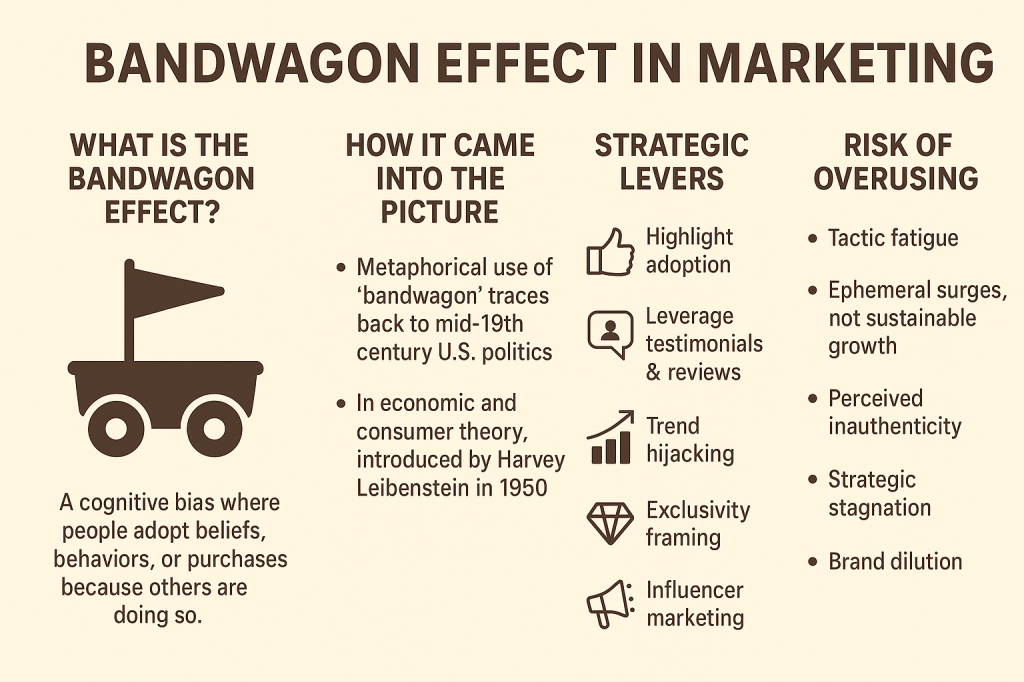
What Is the Bandwagon Effect? Origins & Marketing History
As explained in the Journal of Business Research, the Bandwagon Effect is a cognitive bias: people tend to adopt beliefs, behaviours, or purchases simply because others are doing so. As more people “jump on the bandwagon,” momentum builds, and others follow.
Origins & Etymology
- The metaphorical use of “bandwagon” traces back to American politics in the mid-19th century. In the 1848 U.S. presidential campaign, circus promoter Dan Rice used a literal bandwagon (a wagon carrying a band) to generate publicity, inviting people to “jump on the bandwagon” in support of candidate Zachary Taylor. Number Analytics
- Over time, “jump on the bandwagon” evolved to imply joining a popular movement or trend, often regardless of its substance.
- While the term has political roots, it entered marketing and consumer behavior research over time, with Leibenstein’s work forming the bridge between economic theory and psychological influence in consumption. Hubspot
In marketing, the Bandwagon Effect has been invoked implicitly for decades (e.g. “this is a bestseller,” “everyone’s doing it”). But its academic grounding and systematic study in consumer psychology have gained traction more recently.
Strategic Levers of the Bandwagon Effect (with Brand Examples)
Below are the common tactics marketers use to activate the Bandwagon Effect, along with illustrative examples:
1. Highlight Adoption
This is about showing that many people already use or trust your product—“Over one million sold,” “Trusted by thousands,” or “Most purchased item.”
- Example: Amazon frequently displays “100+ bought in the last hour” to signal high demand and legitimacy.
- This tactic gives social proof and encourages others to follow suit.
2. Leverage Testimonials & Reviews
Real user voices validate the product and humanize the experience. Testimonials are powerful social proof—if people like me endorse it, then maybe I should try it too.
- Example: Beauty brands like Glossier or The Ordinary showcase user testimonials and before/after photos on their websites and social feeds.
- Video or photo testimonials amplify credibility.
3. Trend Hijacking / Riding Cultural Waves
When a trend is rising (e.g., a meme, hashtag, or viral sound), brands insert themselves into that narrative to gain visibility and social momentum.
- Example: Fashion labels adopting trending TikTok challenges or aligning new product drops with viral hashtags (e.g., “#OutfitOfTheDay,” “#CleanGirl aesthetic”).
- Tesla or Apple sometimes ride tech trends (e.g. “everyone’s into AI now”) to frame their releases as part of the zeitgeist.
4. Exclusivity Framing
This is the flip side: making something seem scarce or limited so people rush to join while they can. The perception that “everyone wants it, and it might run out” intensifies the bandwagon.
- Example: Supreme’s limited drops create urgency and long lines, elevating the brand mystique.
- Fashion brands releasing capsule collections or limited editions often highlight “only 500 units made.”
5. Influencer Marketing (Third-Party Validation)
When an influencer with authority or reach uses or endorses a product, their followers interpret it as proof of value.
- Example: Gymshark collaborating with fitness creators, or Daniel Wellington using micro-influencers wearing the watch.
- Influencer endorsements encourage the audience to “join what they’re already doing.”
6. Combining Scarcity + Popularity
Marketers often merge scarcity signals (“only x left”) with popularity indicators (“500 sold today”) to supercharge urgency.
- Example: E-commerce sites showing real-time stock counts (“2 left in your size”) alongside a “people are viewing this now” badge.
- Ticketing platforms often use both: “150 seats left” + “200 people viewing.”
Each lever builds on the notion of social validation: if others are endorsing or using this, it must be worthwhile.
The Risk of Overusing the Bandwagon Approach
While the Bandwagon Effect can spark rapid growth, it’s not a perpetual engine. Overuse or sloppy execution can lead to several pitfalls:
- Tactic fatigue: If every brand is using the same “everyone’s doing it” messaging, audiences grow skeptical. The effect becomes background noise, not persuasive.
- Ephemeral surges, not sustainable growth: Bandwagon behavior might trigger a temporary spike, but it seldom ensures long-term loyalty or retention. Much like fast fashion, trends burn bright and fade fast.
- Perceived inauthenticity: If customers sense that popularity is manufactured (fake reviews, inflated numbers, borrowed trends), trust erodes.
- Strategic stagnation: Relying too heavily on bandwagon effects stifles innovation. It’s easy to replicate success than to create new differentiation.
- Brand dilution: If every campaign tries to scream “everyone’s doing this,” your unique brand narrative can be lost in the noise.
Simply put: the Bandwagon Effect is excellent for ignition, but poor as a long-term fuel. You can’t ride crowd behavior forever without grounding in quality, purpose, or differentiation.
Takeaway for Us Marketers
The Bandwagon Effect is fundamentally about social validation—the desire to belong, to avoid missing out, and to align with perceived consensus. When wielded with care in digital marketing, content strategy, and influencer marketing, it can help drive:
- Trust via reviews, testimonials, social proof
- Virality through trends, memes, and cultural alignment
- Conversions & sales via scarcity + popularity cues
But, like any psychological lever, it demands balance. Use it alongside authenticity, value, and unique brand story—not as a crutch. The strongest brands are those that activate momentum and sustain meaningful relationships beyond the hype.
 The Narrative Muse
Leave a comment